
Sometimes a person barely has to speak before your whole body reacts.
You feel irritated. Defensive. Small. Competitive. Anxious. Angry.
And the frustrating part is that you may not even understand why.
Certain people seem to press emotional buttons that others simply do not. Sometimes the reason is obvious — they remind you of someone, cross a boundary, or behave in a way you dislike. Other times, the intensity feels strangely disproportionate.
That is where trigger work becomes useful.
The best audiobooks about emotional triggers help you look beneath the reaction and ask what is actually being activated: an old wound, an attachment pattern, a boundary issue, a nervous-system response, projection, or a disowned part of yourself.
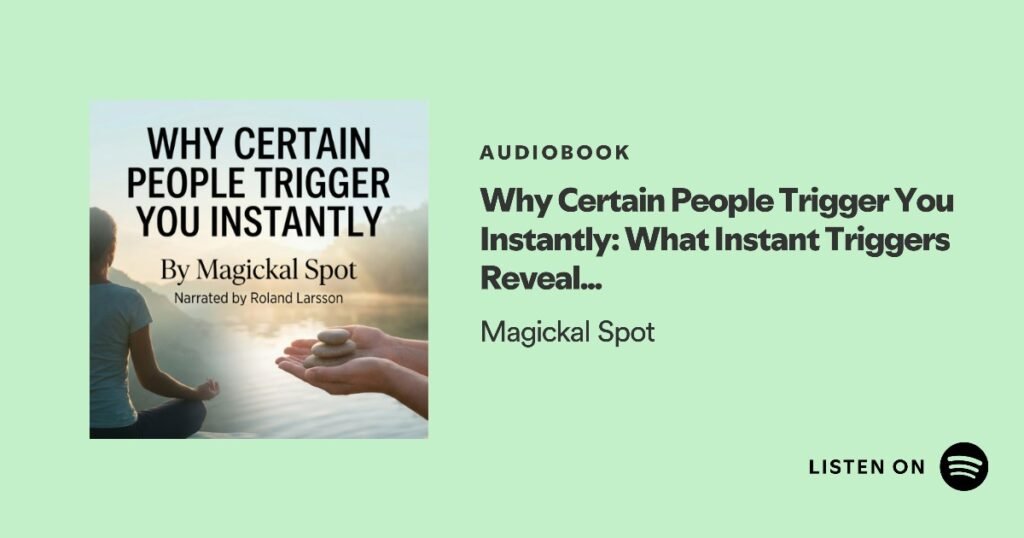
For a short, direct introduction to this exact question, Why Certain People Trigger You Instantly: What Instant Triggers Reveal About Your Shadow, Wounds, and Growth by Magickal Spot is the strongest starting point. It focuses specifically on instant emotional reactions and how they relate to shadow work, childhood wounds, unmet needs, boundaries, and projection. The audiobook is narrated by Roland Larsson and runs about 46 minutes.
Quick Answer
The best audiobook for understanding why certain people trigger you is Why Certain People Trigger You Instantly by Magickal Spot. It directly explores psychological projection, shadow work, childhood and relationship wounds, unmet needs, boundaries, and the difference between intuition and reactive projection.
For deeper psychological context, What Happened to You? by Oprah Winfrey and Dr. Bruce Perry helps explain how early experiences shape adult reactions, Attached by Amir Levine and Rachel Heller explores attachment-based relationship triggers, Set Boundaries, Find Peace by Nedra Glover Tawwab focuses on boundary-related activation, and The Dance of Connection by Harriet Lerner helps with communication when emotions are already running high.
How These Audiobooks Were Chosen
I looked for audiobooks that explain triggers from genuinely different angles rather than repeating the same idea.
The strongest choices needed to help listeners understand at least one of these:
- projection and shadow work
- childhood conditioning
- trauma-related reactions
- attachment styles
- boundaries and resentment
- communication during conflict
- the difference between intuition and emotional reactivity
The point is not to convince yourself that every trigger is “your fault.”
Sometimes someone really is disrespectful, manipulative, unsafe, or incompatible with you.
The useful question is:
What does my reaction tell me about this situation — and about me?
1. Why Certain People Trigger You Instantly by Magickal Spot
Best Overall for Understanding Instant Emotional Triggers
This audiobook begins with one of the most relatable questions in shadow work:
Why can someone irritate you almost instantly, even when they have barely done anything?
Why Certain People Trigger You Instantly argues that strong reactions are often not random. They may point toward:
- an unhealed wound
- a rejected part of yourself
- an unmet need
- a weak or crossed boundary
- an old relationship pattern
- psychological projection
- a part of the psyche asking for attention
That makes the audiobook more nuanced than the usual “everyone who triggers you is your mirror” advice.
Sometimes a trigger is projection.
Sometimes it is intuition.
Sometimes somebody is actually crossing a line.
The useful work is learning to tell the difference.
Projection: When the Reaction Is Bigger Than the Moment
Projection is one of the core ideas explored in the audiobook.
You may meet someone who is extremely outspoken and immediately decide they are obnoxious.
Maybe they are.
But another possibility is that you were taught not to speak freely, and their confidence activates something you disowned in yourself.
Or perhaps a needy person irritates you because your own needs were historically treated as unacceptable.
Or someone’s ambition bothers you because you learned that wanting recognition was selfish.
Shadow work does not tell you your judgment is always wrong.
It simply asks why certain qualities create such a strong charge.
That is a much more useful question.
Childhood Wounds and Relationship Patterns
The audiobook also connects present-day reactions to older experiences.
Someone who is emotionally unavailable may trigger intense anxiety because inconsistency was familiar in childhood.
Someone controlling may provoke an unusually strong response because autonomy was restricted earlier in life.
Someone dismissive may activate a wound around never feeling heard.
The present person may not be identical to the person from your past.
But your nervous system can respond as though an old pattern has returned.
Understanding that difference creates space between stimulus and reaction.
Boundaries Can Look Like Triggers Too
Not every emotional reaction means you need to heal yourself into tolerating somebody.
Sometimes irritation is information.
If someone repeatedly ignores your limits, monopolizes your time, insults you, pressures you, or expects emotional labor from you, the reaction may simply be signaling:
Something here needs a boundary.
This distinction is one of the more useful parts of the audiobook.
It helps move trigger work away from self-blame.
The question becomes:
Is this reaction revealing something inside me, something happening between us, or both?
Intuition vs. Reactive Projection
This is probably one of the most important distinctions in the entire topic.
A strong negative feeling about someone does not automatically mean your intuition is warning you.
But it does not automatically mean you are projecting either.
The audiobook encourages listeners to notice the quality of the response.
Reactive projection tends to come with:
- emotional charge
- assumptions
- old narratives
- urgency
- defensiveness
Intuition is often quieter.
It may simply register:
No. Something is off here.
Learning the difference takes practice, especially if past experiences have made your nervous system highly vigilant.
Best for
- people who are easily triggered by specific personalities
- recurring relationship conflicts
- shadow-work beginners
- people interested in projection
- anyone unsure whether a reaction is intuition, trauma, or boundary information
Kobo lists the audiobook at roughly 0.8 hours, while Storytel lists it at 46 minutes.
Explore Why Certain People Trigger You Instantly
2. What Happened to You? by Oprah Winfrey and Dr. Bruce Perry
Best for Understanding Why Old Experiences Shape Current Reactions
If your triggers feel deeper than ordinary irritation, What Happened to You? is an excellent next listen.
Oprah Winfrey and psychiatrist and trauma expert Dr. Bruce Perry explore how early experiences influence emotional reactions, behavior, relationships, and the way the brain responds to stress.
The central shift is beautifully simple:
Instead of asking:
“What is wrong with me?”
ask:
“What happened to me?”
Audible describes the audiobook as an exploration of how childhood adversity can influence who people become, combining personal stories with brain science and trauma research. It is narrated by Winfrey and Perry themselves.
Why It Helps With Triggers
A trigger is often less about the objective size of the event and more about what the nervous system associates with it.
Someone raises their voice.
Another person thinks nothing of it.
Your body goes straight into panic.
That difference may have history behind it.
Understanding that history does not mean blaming everything on childhood.
It simply makes present reactions easier to understand.
Best for
- trauma-related triggers
- childhood adversity
- nervous-system reactivity
- people who shame themselves for “overreacting”
- listeners who want a science-informed perspective
Listen to What Happened to You? on Audible
3. Attached by Amir Levine and Rachel Heller
Best for Relationship and Attachment Triggers
Sometimes the people who trigger us most intensely are the people we are closest to.
Attached explores adult attachment through three broad styles:
- anxious
- avoidant
- secure
Audible describes the audiobook as a guide to understanding how attachment patterns influence romantic relationships, including anxious preoccupation with closeness and avoidant discomfort with intimacy.
This framework can explain reactions that otherwise seem irrational.
For example:
An anxious person may interpret delayed messages as rejection.
An avoidant person may experience ordinary emotional closeness as pressure.
Neither response necessarily describes what is objectively happening.
It describes how the attachment system is interpreting what is happening.
Why It Belongs on This List
If one type of person reliably sends you into panic, pursuit, withdrawal, or emotional shutdown, attachment theory can provide a very useful lens.
It is particularly helpful when triggers occur in:
- dating
- romantic relationships
- situations involving emotional distance
- fear of abandonment
- fear of losing independence
Best for
People whose strongest triggers show up around intimacy, rejection, closeness, or emotional availability.
4. Set Boundaries, Find Peace by Nedra Glover Tawwab
Best for Triggers That Are Really Boundary Problems
Sometimes you are not “too sensitive.”
You are overextended.
Resentful.
Saying yes when you want to say no.
Allowing behavior that repeatedly makes you uncomfortable.
That is where Set Boundaries, Find Peace becomes useful.
Nedra Glover Tawwab is a licensed counselor and relationship expert, and Audible describes the audiobook as a practical guide to identifying needs, communicating limits, saying no, and creating healthier relationships. Tawwab narrates the audiobook herself.
This is particularly valuable because resentment often masquerades as triggering.
Someone asks you for something.
You immediately feel furious.
The problem may not be the request.
It may be that you have spent years believing you are not allowed to refuse.
Triggers as Boundary Information
Ask yourself:
Would this person still trigger me as strongly if I felt completely free to say no?
That question can reveal a lot.
Some emotional intensity comes from feeling trapped rather than from the other person alone.
Best for
- people-pleasers
- resentment
- guilt around saying no
- emotionally demanding relationships
- recurring boundary violations
Listen to Set Boundaries, Find Peace on Audible
5. The Dance of Connection by Harriet Lerner
Best for What to Do After You’re Triggered
Understanding why someone activates you is valuable.
But eventually you still have to talk to them.
The Dance of Connection by psychologist Harriet Lerner focuses on communicating when you feel angry, hurt, scared, frustrated, insulted, or desperate.
Audible describes the audiobook as a guide to finding and expressing an authentic voice in important relationships, particularly when conversations repeatedly become painful or unproductive. Lerner narrates the audiobook herself.
This makes it a useful final step in the process.
First you recognize the trigger.
Then you understand its roots.
Then you decide whether a boundary or conversation is needed.
And finally, you have to communicate without simply dumping the emotional charge onto the other person.
Best for
- recurring arguments
- difficult family conversations
- relationship conflict
- people who shut down when triggered
- people who become reactive when they feel unheard
Listen to The Dance of Connection on Audible
Audiobooks About Emotional Triggers Compared
| Audiobook | Main Focus | Best For |
|---|---|---|
| Why Certain People Trigger You Instantly | Shadow, projection, wounds, boundaries | Understanding instant triggers |
| What Happened to You? | Trauma and early experience | Deep nervous-system reactions |
| Attached | Attachment styles | Romantic relationship triggers |
| Set Boundaries, Find Peace | Boundaries and needs | Resentment and people-pleasing |
| The Dance of Connection | Communication | Handling conflict after activation |
Why Do Certain People Trigger You More Than Others?
There is no single explanation.
A person may trigger you because they:
- resemble someone from your past
- express a trait you suppress
- activate an attachment wound
- violate a boundary
- behave unpredictably
- remind you of something unresolved
- challenge your identity
- make you feel rejected, controlled, ignored, or unsafe
Several of these may happen at the same time.
That is why trigger work becomes much more useful when you stop asking:
“Why are they so annoying?”
and begin asking:
“What exactly is happening inside me around this person?”
Are Triggers Always About You?
No.
This is an important correction to oversimplified shadow-work advice.
If somebody lies to you repeatedly and you become angry, that does not automatically mean you need to integrate your “inner liar.”
Sometimes anger means:
I don’t trust this person.
If somebody ignores your boundaries and you become uncomfortable, that may not be unresolved shadow material.
It may simply be a healthy response to disrespect.
Good trigger work includes both self-reflection and reality testing.
Ask:
Is this revealing something unresolved in me?
and:
Is something genuinely unhealthy happening here?
Both can be true.
What Is the Difference Between a Trigger and Intuition?
The two can feel similar because both involve fast internal reactions.
A trigger often carries an emotional history.
It may feel:
- urgent
- highly charged
- familiar
- defensive
- catastrophic
Intuition is often described as quieter and simpler.
Rather than:
“GET AWAY FROM THIS PERSON RIGHT NOW BECAUSE THIS IS GOING TO END TERRIBLY.”
it may feel more like:
“No. This person isn’t right for me.”
There is no perfect formula for distinguishing the two.
Context, self-awareness, and time help.
If you are unsure, slowing down before acting is usually more useful than immediately obeying either fear or a spiritual interpretation.
Why Do Confident People Trigger Me?
Confidence can activate shadow material when you have been taught to suppress your own authority, visibility, ambition, or self-expression.
But context matters.
Someone may also genuinely behave arrogantly.
The shadow-work question is not:
“Everything I dislike is secretly me.”
It is:
“Why does this particular quality create such a strong reaction in me?”
That distinction prevents shadow work from becoming self-gaslighting.
Why Does Being Ignored Trigger Me So Much?
Being ignored can activate attachment fears, childhood experiences of emotional neglect, rejection sensitivity, or a simple need for communication and respect.
If the reaction feels especially intense, books such as Attached and What Happened to You? can help clarify the underlying pattern.
Why Do I Keep Getting Triggered by the Same Type of Person?
Repeated patterns often suggest that the surface personalities are different while the underlying emotional dynamic is similar.
You may repeatedly encounter:
- emotionally unavailable partners
- highly critical authority figures
- controlling personalities
- people who need rescuing
- dismissive friends
- boundary-pushers
At some point, the pattern becomes more useful to study than any individual person.
Ask:
**What role