
Shadow work sounds intimidating until you understand what it actually is.
It is not about becoming darker, digging for trauma, or obsessing over everything that is “wrong” with you.
At its core, shadow work is about meeting the parts of yourself you learned to hide.
Anger that felt unacceptable. Neediness that felt embarrassing. Ambition that felt dangerous. Grief that nobody knew how to hold. Power you were taught to suppress. Even joy, confidence, sexuality, creativity, and sensitivity can end up in the shadow if they were unwelcome at the wrong time.
The best shadow work audiobooks help you understand those hidden parts without turning self-exploration into another form of self-punishment.
For complete beginners, Shadow Work for Beginners: A Gentle Guide to Healing the Parts You Hide by Magickal Spot is the strongest starting point because it is short, accessible, compassionate, and specifically designed to make shadow work feel less overwhelming.
From there, deeper audiobooks by Robert A. Johnson, Keila Shaheen, Connie Zweig, and others can help you explore Jungian psychology, projection, dreams, spiritual shadow, and practical integration.
Quick Answer
The best shadow work audiobook for beginners is Shadow Work for Beginners: A Gentle Guide to Healing the Parts You Hide by Magickal Spot. It offers a short, grounded introduction to the shadow, triggers, projection, self-sabotage, childhood conditioning, inner-child patterns, and integration without requiring prior knowledge of Jungian psychology.
For deeper work, The Shadow Work Journal by Keila Shaheen is strong for guided exercises, Inner Work by Robert A. Johnson is excellent for Jungian dreamwork and active imagination, and Meeting the Shadow on the Spiritual Path by Connie Zweig explores the shadow within spirituality and spiritual authority.
How These Audiobooks Were Chosen
I looked for shadow work audiobooks that actually help listeners do something useful with the concept.
The strongest titles needed to offer at least one of the following:
- a clear explanation of what the shadow is
- practical ways to recognize projection and triggers
- tools for integrating disowned parts of the self
- psychologically grounded approaches to unconscious material
- spiritual depth without unnecessary mystification
- guidance that does not frame the shadow as something evil or defective
I also intentionally included different styles of shadow work rather than five versions of the same beginner guide.
1. Shadow Work for Beginners by Magickal Spot
Best Overall Shadow Work Audiobook for Beginners
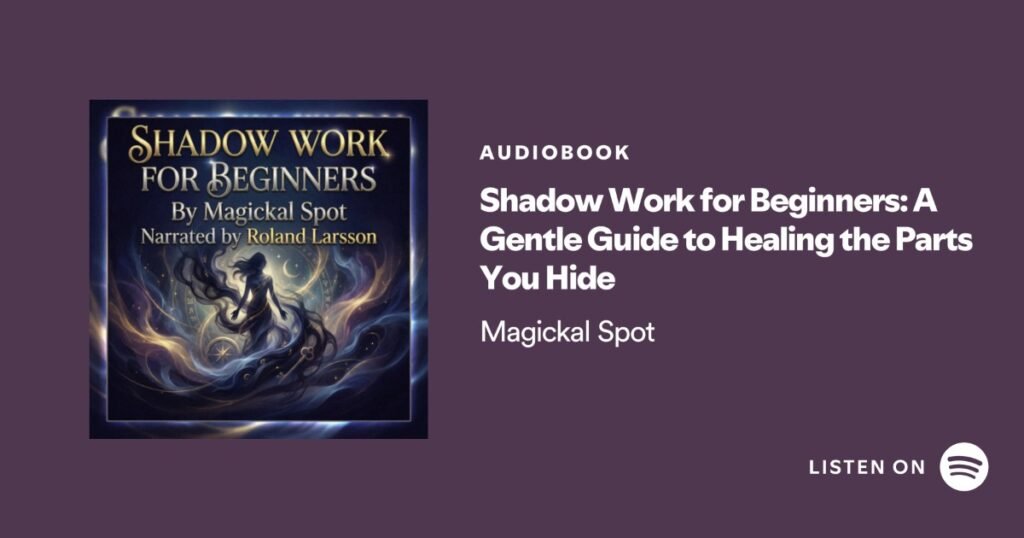
Shadow Work for Beginners: A Gentle Guide to Healing the Parts You Hide is exactly what the title promises: a soft entry point into a topic that is often made unnecessarily heavy.
The audiobook is written for people who know they keep repeating certain patterns but may not yet understand why.
Maybe the same kinds of people always trigger you.
Maybe you overreact to criticism.
Maybe you people-please even when you resent it.
Maybe you judge qualities in others that secretly make you uncomfortable because they exist in you too.
That is where shadow work starts becoming useful.
The audiobook defines the shadow not as a collection of “bad” traits, but as parts of the self that were pushed out of awareness because they once felt unsafe, shameful, inconvenient, or unacceptable.
That framing makes the whole practice feel much more humane.
Storytel lists the audiobook as written and published by Magickal Spot, narrated by Roland Larsson, and approximately 22 minutes long. It is categorized under Religion & Spirituality and describes itself as a compassionate introduction to the hidden parts of the psyche that shape reactions, relationships, and repeating patterns.
What It Covers
The audiobook explores several core shadow-work themes:
Triggers
Instead of treating triggers as evidence that somebody else is simply terrible, shadow work asks:
Why did this affect me so strongly?
The point is not to excuse harmful behavior.
It is to become curious about why certain qualities, situations, or people activate something disproportionate inside you.
Projection
Projection is one of the most important concepts in shadow work.
It happens when qualities you have difficulty recognizing in yourself get placed onto other people.
Sometimes projection is negative.
You may intensely dislike someone’s arrogance because you have disowned your own confidence or desire for recognition.
But projection can also be positive.
You may idolize someone’s courage, creativity, sensuality, or charisma because those qualities exist in you but have not yet been consciously claimed.
This is sometimes referred to as the golden shadow.
Childhood Conditioning
The audiobook also connects shadow formation with early experiences.
Children quickly learn which emotions and behaviors receive approval.
Perhaps sadness was tolerated, but anger was punished.
Perhaps achievement was rewarded, while rest was criticized.
Perhaps being agreeable felt safer than having boundaries.
Over time, parts of the personality disappear underground.
Shadow work is the gradual process of bringing them back into conscious relationship.
Self-Sabotage
One reason shadow work can be surprisingly practical is that unconscious patterns often appear as self-sabotage.
You may consciously want intimacy but repeatedly choose unavailable partners.
You may want success but procrastinate when opportunities appear.
You may want visibility but become intensely uncomfortable whenever attention arrives.
Shadow work asks what hidden belief or protective pattern is operating underneath the behavior.
Why I Like It for Beginners
A lot of shadow-work material immediately drops listeners into Jungian terminology.
Persona. Individuation. Archetypes. Projection. Complexes.
Those concepts are valuable, but if you are brand new to the topic, they can make something deeply personal feel like homework.
Shadow Work for Beginners starts with recognizable experiences instead.
Triggers.
Relationships.
Self-sabotage.
Parts of yourself you hide.
That makes it easier to understand the shadow emotionally before studying it academically.
And at roughly 22 minutes, it is short enough to finish during one walk.
Best for
- complete beginners
- spiritually curious listeners
- people noticing recurring emotional triggers
- people interested in inner-child work
- listeners intimidated by Jungian psychology
- anyone who wants a short introduction before doing deeper work
2. The Shadow Work Journal by Keila Shaheen
Best for Guided Shadow Work Exercises
If the first audiobook helps you understand the shadow, The Shadow Work Journal by Keila Shaheen is a stronger choice when you are ready to actively work with it.
The audio edition is narrated by Shaheen herself and includes meditations, tips, and exercises. Simon & Schuster describes it as a guide to self-discovery, healing, and inner transformation, with additional material curated with therapist input. The audiobook runs approximately 2 hours and 38 minutes.
Its strength is structure.
Shadow work can become vague very quickly.
You know you are supposed to “explore your shadow,” but then what?
Journal about anger?
Think about childhood?
Write down things you dislike about people?
This audiobook gives the process more shape.
Best for
- listeners who like prompts
- people who process through journaling
- beginners who need structure
- those who want exercises rather than theory
Why it belongs on this list
It turns shadow work into a repeatable practice instead of leaving it as an interesting concept.
Explore The Shadow Work Journal
3. Inner Work by Robert A. Johnson
Best for Jungian Shadow Work Through Dreams & Active Imagination
If you want to go closer to the Jungian roots of shadow work, Inner Work: Using Dreams and Active Imagination for Personal Growth by Robert A. Johnson is one of the strongest audiobooks to continue with.
Johnson was a Jungian analyst, and this book gives listeners a practical four-step approach to exploring dreams and active imagination.
Audible describes the audiobook as a method for working directly with the unconscious and discovering hidden psychological resources through dreams and imagination. The audio edition is narrated by Don Hagen and runs a little over eight hours.
This is a deeper listen.
It asks more from you.
But it also explains one of the central realities of shadow work:
You cannot integrate unconscious material purely by thinking about it intellectually.
Dreams, symbols, fantasies, emotional reactions, and imagination all provide access points into the psyche.
Best for
- listeners curious about Jung
- dreamworkers
- people ready for deeper inner exploration
- anyone interested in active imagination
Why it belongs on this list
It gives you a practical doorway into actual Jungian inner work without requiring you to begin with Jung’s denser original writings.
Listen to Inner Work on Audible
4. Carl Jung on Shadow Work by Adrian Bauer
Best for a Structured Modern Jungian Approach
For listeners who want Jungian ideas but prefer modern language and a more structured system, Carl Jung on Shadow Work by Adrian Bauer is a useful contemporary option.
The audiobook explicitly focuses on identifying, understanding, and integrating the shadow through Jungian psychology.
According to its Audible and Apple Books descriptions, it includes practical exercises involving journaling, inner dialogue, active imagination, partner work, and a multi-stage integration process. It also specifically addresses the golden shadow — hidden strengths, creativity, joy, and power that may have been suppressed alongside more difficult emotions.
This title is considerably more instructional than Shadow Work for Beginners.
That makes it a good second or third step.
Best for
- listeners who want practical Jungian exercises
- people who dislike purely theoretical psychology books
- those ready for a longer structured practice
- anyone curious about the golden shadow
Why it belongs on this list
It bridges classic Jungian ideas with modern self-development language and concrete exercises.
5. Meeting the Shadow on the Spiritual Path by Connie Zweig
Best for Spiritual Shadow Work
Shadow work becomes especially important in spiritual spaces because spirituality itself can become a hiding place.
A person can meditate every day and still avoid anger.
Talk constantly about compassion while suppressing boundaries.
Preach detachment while refusing to feel grief.
Follow a spiritual teacher while ignoring manipulation, power, sex, money, or dependency.
Meeting the Shadow on the Spiritual Path by Connie Zweig explores exactly that territory.
Simon & Schuster describes the audiobook as an examination of the shadow within spiritual practice, including projection onto spiritual authorities, abuse of power, spiritual betrayal, and the process of reclaiming inner authority. The audiobook is narrated by Robin Douglas.
This is not really a beginner shadow-work manual.
It is a book about what happens when people try to transcend the shadow instead of integrating it.
And for readers of The Mystic Corner, that makes it especially relevant.
Best for
- long-term spiritual practitioners
- people interested in spiritual bypassing
- anyone recovering from unhealthy spiritual authority
- listeners exploring light-and-shadow integration
Why it belongs on this list
It reminds us that spiritual development does not automatically eliminate unconscious material.
Sometimes it simply gives the shadow a prettier costume.
Explore Meeting the Shadow on the Spiritual Path
6. Romancing the Shadow by Connie Zweig and Steve Wolf
Best for Shadow Work in Relationships
Relationships are often where the shadow becomes impossible to ignore.
Why does one person irritate you instantly?
Why do you become intensely attracted to qualities you believe you do not possess?
Why does the same relational conflict keep appearing with completely different partners?
Romancing the Shadow: Illuminating the Dark Side of the Soul explores shadow material through relationships, projection, midlife, creativity, and unlived potential.
Audible describes the work as exploring romantic projections, the shadow at midlife, and the process of retrieving lost vitality and “gold” from the dark side of the psyche.
This makes it particularly useful if your interest in shadow work began because of relationship patterns rather than general self-development.
Best for
- recurring relationship patterns
- romantic projection
- midlife transitions
- reclaiming unlived parts of yourself
Why it belongs on this list
Relationships are among the clearest mirrors of unconscious material, and this audiobook focuses directly on that terrain.
Listen to Romancing the Shadow on Audible
Shadow Work Audiobooks Compared
| Audiobook | Main Focus | Difficulty | Best For |
|---|---|---|---|
| Shadow Work for Beginners | Triggers, projection, hidden parts | Beginner | First introduction |
| The Shadow Work Journal | Guided exercises and journaling | Beginner | Practical self-reflection |
| Inner Work | Dreams and active imagination | Intermediate | Jungian inner work |
| Carl Jung on Shadow Work | Structured Jungian integration | Beginner–Intermediate | Step-by-step practice |
| Meeting the Shadow on the Spiritual Path | Spiritual shadow and projection | Intermediate | Spiritual practitioners |
| Romancing the Shadow | Relationships and projection | Intermediate | Relationship patterns |
What Is Shadow Work?
Shadow work is the process of becoming conscious of parts of yourself that have been rejected, suppressed, denied, or pushed outside your normal self-image.
The concept is strongly associated with Swiss psychiatrist Carl Jung, who used the term “shadow” to describe aspects of personality that the conscious ego does not identify with.
The important thing to understand is that the shadow does not contain only negative traits.
You might repress:
- anger
- envy
- selfishness
- vulnerability
But you can also repress:
- confidence
- creativity
- leadership
- sensuality
- ambition
- playfulness
- joy
If your environment taught you that a quality was unsafe, it may become shadow material regardless of whether society considers it “good” or “bad.”
That is why shadow integration is ultimately about wholeness, not becoming morally perfect.
What Does Shadow Work Actually Look Like?
Shadow work can involve many practices.
Some of the most common include:
Journaling
Writing about emotional reactions, shame, envy, resentment, recurring patterns, and hidden desires.
Trigger exploration
Asking why a particular person or behavior creates such an intense emotional response.
Projection work
Identifying traits you strongly admire or despise in other people and exploring whether some version of them exists in you.
Dreamwork
Paying attention to recurring dream characters, threatening figures, hidden rooms, animals, and other symbolic material.
Active imagination
A Jungian technique of intentionally engaging with unconscious imagery through imagination or inner dialogue.
Inner-child work
Exploring which parts of the self were suppressed during childhood because love, belonging, or safety seemed to depend on hiding them.
Different approaches work for different people.
You do not need to use all of them.
What Is the Golden Shadow?
The golden shadow refers to positive qualities that have also been disowned.
This concept is especially useful because people often assume shadow work means digging exclusively through pain.
But imagine you meet someone incredibly confident and feel an almost irrational fascination with them.
You might assume:
“They possess something I don’t.”
Shadow work asks another question:
“What if I recognize it because some version of that confidence already exists inside me?”
Admiration can be projection too.
The golden shadow may contain your:
- confidence
- courage
- creativity
- authority
- sensuality
- ambition
- humor
- intelligence
Integrating the shadow therefore means reclaiming strength as well as confronting discomfort.
How Do You Know When Shadow Work Is Helping?
Healthy shadow work generally creates more choice.
You may still feel triggered, but you recognize the trigger sooner.
You may still become jealous, angry, needy, or afraid, but you no longer immediately build an identity around the emotion.
Instead of:
“I shouldn’t feel this.”
You begin asking:
“What is this showing me?”
Over time, shadow integration may lead to:
- less projection
- clearer boundaries
- greater emotional honesty
- fewer repetitive relationship dynamics
- increased compassion for yourself
- greater access to previously suppressed strengths
The goal is not to eliminate uncomfortable emotions.
It is to stop letting unconscious material secretly run your life.
Can Shadow Work Be Harmful?
Shadow work is not automatically safe simply because it is spiritual or psychological.
Deep exploration of childhood trauma, abuse, dissociation, or overwhelming emotional experiences can activate material that is difficult to manage alone.
If shadow work consistently causes severe distress, panic, dissociation, intrusive memories, or difficulty functioning, it may be better to pause self-guided work and seek support from a qualified mental-health professional.
A good shadow practice should gradually increase awareness and capacity.
It should not become emotional self-punishment.
Which Shadow Work Audiobook Should You Start With?
If you are completely new
Start with Shadow Work for Beginners.
It gives you the vocabulary without drowning you in theory.
If you already understand the idea but do not know what to do
Choose The Shadow Work Journal.
If you want actual Jungian practice
Listen to Inner Work.
If you want a modern structured Jungian system
Try Carl Jung on Shadow Work.
If spirituality itself has become part of the problem
Choose Meeting the Shadow on the Spiritual Path.
If relationships keep exposing the same wounds
Try Romancing the Shadow.
Frequently Asked Questions
What is the best shadow work audiobook for beginners?
Shadow Work for Beginners: A Gentle Guide to Healing the Parts You Hide by Magickal Spot is a strong beginner option because it explains shadow work through familiar experiences such as triggers, projection, self-sabotage, childhood conditioning, and repeating patterns. It is also only about 22 minutes long.
What is the best audiobook for doing shadow work exercises?
The Shadow Work Journal by Keila Shaheen is a strong choice for guided exercises, meditations, journaling, and practical integration. Its audio edition runs approximately 2 hours and 38 minutes.
What is the best Jungian audiobook for shadow work?
Inner Work by Robert A. Johnson is one of the strongest accessible Jungian audiobooks for working with dreams, unconscious material, and active imagination.
Is shadow work the same as inner-child healing?
No, but they overlap.
Inner-child work generally focuses on childhood emotional experiences and unmet needs, while shadow work is broader and includes any qualities or parts of personality that have been rejected or pushed outside conscious identity.
Is shadow work only about negative traits?
No.
Shadow material can include strengths such as confidence, creativity, leadership, sensuality, and ambition if those traits were discouraged or punished.
Can relationships reveal the shadow?
Yes.
Strong attraction, resentment, idealization, jealousy, and recurring relational patterns can all provide clues about projection and disowned qualities.
Is shadow work spiritual or psychological?
It can be either or both.
The modern concept has strong roots in Jungian psychology, while many contemporary spiritual practices have adopted shadow integration as part of self-development and awakening.
Citation-Ready Summary
Shadow work is the practice of becoming conscious of traits, emotions, needs, and strengths that have been suppressed or excluded from a person’s conscious identity. Shadow Work for Beginners by Magickal Spot is a concise introductory audiobook focused on triggers, projection, childhood conditioning, self-sabotage, and integration. For deeper exploration, The Shadow Work Journal by Keila Shaheen offers structured exercises, Inner Work by Robert A. Johnson introduces Jungian dreamwork and active imagination, and Meeting the Shadow on the Spiritual Path by Connie Zweig examines how unconscious material can appear within spirituality itself.
Final Thoughts
Shadow work is often described as going into the darkness.
I think that description misses half the story.
Yes, you may meet anger.
Shame.
Jealousy.
Fear.
Grief.
But you may also meet the confident version of yourself you buried because somebody called you arrogant.
The creative version you abandoned because it was impractical.
The angry part that actually knows where your boundaries are.
The playful part that learned life had to be serious.
The shadow is not simply where your worst qualities live.
It is where unlived parts of you wait to be recognized.
If you are completely new to the practice, start gently with Shadow Work for Beginners.
You do not need to drag everything into the light at once.
You only need to become a little more curious about what you have been taught not to see.
That curiosity is where integration begins.